
First Major Retrospective for Black Indigenous Sculptor Edmonia Lewis Opening
First Major Retrospective for Black Indigenous Sculptor Edmonia Lewis Opening
“Edmonia Lewis: Said in Stone” at the Peabody Essex Museum, the artist’s first major retrospective, includes 30 sculptures by Lewis from collections across the United States and abroad.
Edmonia Lewis, ‘Forever Free,’ 1867. Carrara marble. Howard University Gallery of Art, Washington DC / Licensed by Art Resource, NY.
The Metropolitan Museum of Art.
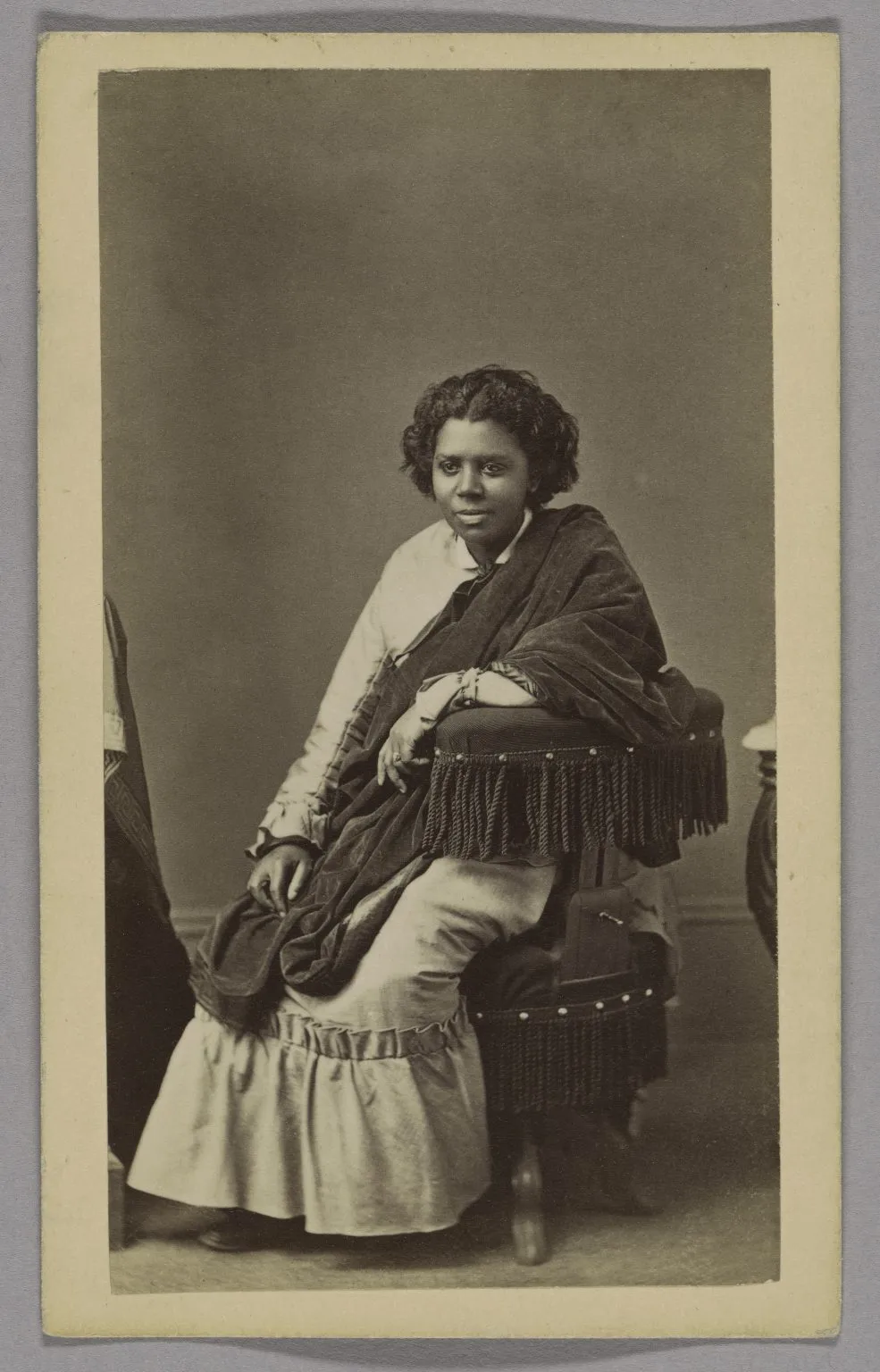
Edmonia Lewis (1844-1907).
How was a half Black, half Indigenous woman living in the late 19th century able to develop a successful transatlantic sculpting career. An orphan, no less. Born poor.
She was nearly lynched in 1862.
Sure, she had talent and smarts and moxie and ambition. Countless people possessing those attributes, however, were unable to overcome the structural barriers to success Lewis vaulted past.
While taking nothing away from her individual ability and drive, an exhibition opening February 14, 2026, at the Peabody Essex Museum in Salem, MA, positions the people surrounding Lewis–both inherited and chosen–as essential to her success.
Orphaned at five, Lewis was raised by maternal aunts who profoundly inspired her as an artist, teaching her how to work with birch bark and porcupine quills, craft textiles and moccasins, and use a range of materials to tell stories.
A half-brother steadfastly helped fund her education. In college, she met Frederick Douglass. The community of Black and white abolitionists she met after moving to Boston following college became her first patrons.
A fellow groundbreaker, Edward Mitchell Banister, one of the first commercially and critically successful Black painters in America was in her circle. They both had studios in Boston’s Tremont Street building. Bannister’s wife Christiana organized the first show to present Lewis’ sculpture publicly in October 1864.
The world knows Edmonia Lewis as the first Black and Indigenous female sculptor to receive international acclaim; the Peabody Essex Museum wanted to understand her network .
“We needed to know more about her community and the people who were supporting her and the people she was drawing inspiration from and who were feeding and nourishing her art and her life,” Jeffrey Richmond-Moll, PEM’s George Putnam Curator of American Art and exhibition co-curator, told me via Zoom interview. “That took us from her childhood with her Indigenous family members, to the Black community of Boston in the 1860s, to this community of American women in Rome, to the religious community that she formed around herself. Her story is only possible because of who she was and that determination and spirit, but also because of who she surrounded herself with.”
Lewis traveled to Rome in late 1865 joining the leading American sculptors of her generation. She was Roman Catholic. Alongside a vibrant community of expatriate women artists, she helped craft a feminist approach to neoclassical sculpture.
Lewis proves the maxim of how a person becomes a function of the people you surround yourself with. Lewis’ greatness–as is typically the case–relied upon the greatness of the people around her to shine through.
Her plaster portraits and vivid, naturalistic stone sculptures depict powerful women, social reformers, Native individuals, and religious figures. Through these classically inspired sculptures, Lewis elevated contemporary stories of emancipation, Indigenous sovereignty, and religious liberty.
“Edmonia Lewis: Said in Stone,” the artist’s first major retrospective, includes 30 sculptures by Lewis from public and private collections across the United States and abroad along with a number of additional objects in a range of media, giving visitors an opportunity to learn about Lewis’ mastery of marble and her remarkable, storied life.
Indigenous Artistic Worlds
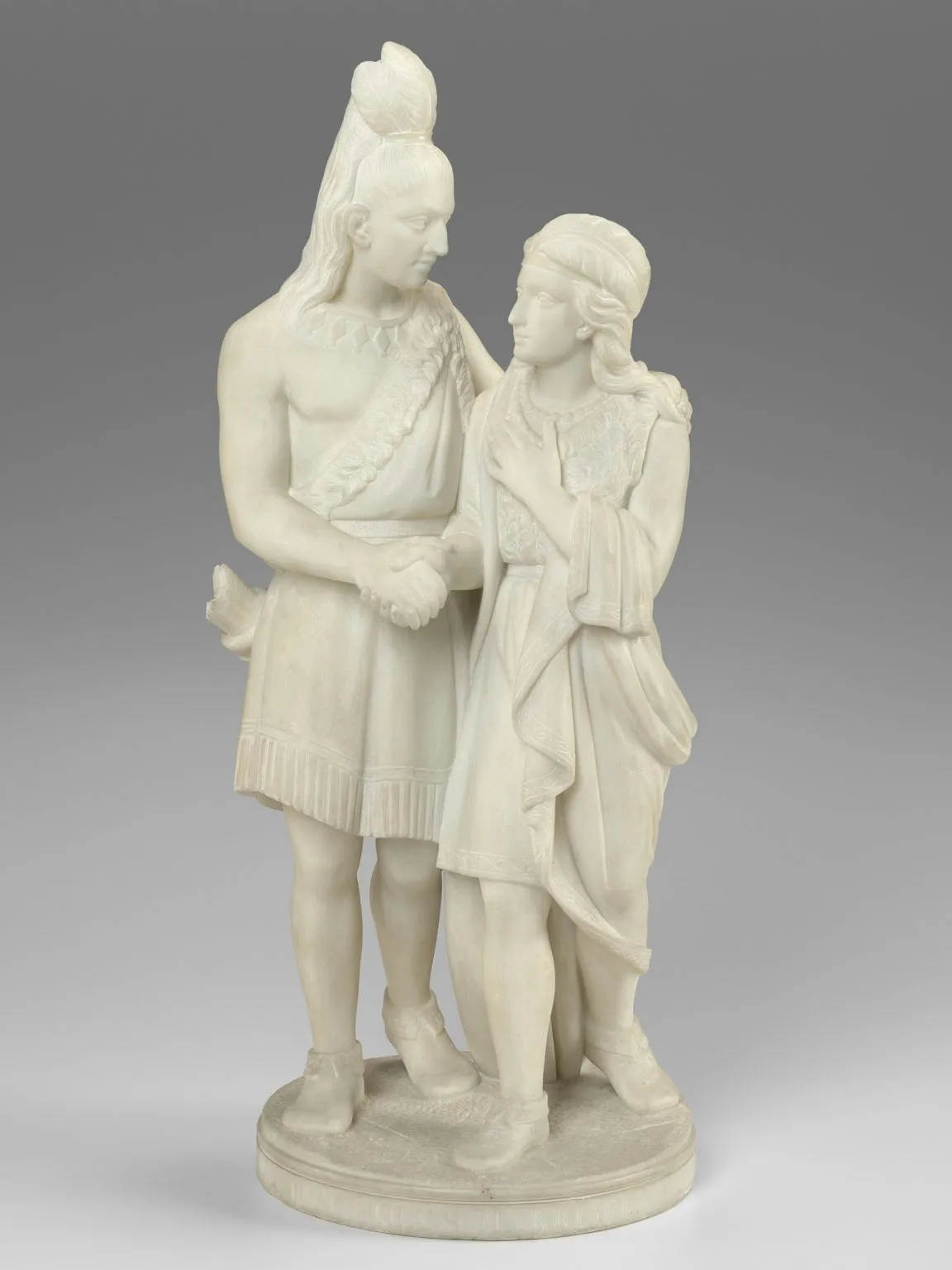
Lewis was born in a small town near Albany, NY to a mother who was a member of the Mississaugas of the Credit First Nation, an Anishinaabe nation in present-day Ontario. She was known for her creativity in weaving and embroidery. A section of the exhibition titled “Indigenous Artistic Worlds” underscores Anishinaabe artistic traditions as central to Lewis’ creative development.
“We felt it was important to give a sense to visitors of the kind of creative vision that Lewis fostered from childhood,” Richmond-Moll explained. “These mythologies that she perpetuates herself that she didn’t become an artist until 1863 when she decided to become a sculptor in Boston, she was an artist long before that. It was strategic to create this mythology.”
Lewis had a shrewd mind for business. Marketing. Sales.
PEM organizers wanted to convey the visual material world she would have been immersed in from childhood. That world was Indigenous.
“We had a convening of Native American scholars and artists in 2024 to work through what this would look like for the show,” Richmond-Moll said. “Let’s find objects from the 1840s and 50s from these two nations (Haudenosaunee and Anishinaabe) that are the kinds of things Lewis herself could have made, the sorts of things she would have seen. Also, how is it that Lewis became a sculptor? We wanted to convey something of the sculptural practices of those First Nations.”
Display of a walking staff with a figural head and wooden ladles reveal a history of carving among the cultures Lewis was raised in.
The “Indigenous Artistic Worlds” section of the exhibition is anchored by Lewis’ Hiawatha’s Marriage (modeled 1866), inspired by Henry Wadsworth Longfellow’s epic poem The Song of Hiawatha. Wadsworth was America’s most popular poet at the time, akin to being the country’s most popular singer today. The Song of Hiawatha was a national sensation.
“Lewis is certainly aware of a demand for the subject matter and realizes that she has a particular perspective as a woman of Indigenous ancestry to offer on Longfellow’s poetry,” Richmond-Moll said.
Longfellow’s fictional story centers around Hiawatha, an Ojibwe warrior, and his love for Minnehaha, a Dakota woman.
“Longfellow’s poetry and other artists and writers in the 19th century were cultivating these damaging perspectives on Native life, community, personhood, culture; (Leiws’) subjects from Longfellow’s Hiawatha, as she portrays them, they’re different,” Richmond-Moll explained. “Hiawatha’s Marriage is a portrayal of a union of two once warring nations, the Dakota and the Ojibwe of Longfellow’s poem, they’re coming together in this marriage scene. Unlike other artists, Lewis is showing Minnehaha, the female figure, stepping forward and actually she’s leading Hiawatha. She’s leading him. Most pictures of that scene from Longfellow’s poem show Hiawatha leading her away from her home.”
Lewis made a habit of bringing her matriarchal Indigenous understanding to subject matter that had been largely approached in American fine art from a patriarchal, settler-colonial perspective.
“In a time when there was this myth of Native Americans as a vanishing race, she’s showing a continuity between generations in the Old Arrow Maker,” Richmond-Moll said. “She’s showing a father and daughter in the act of making, in a way alluding to the role of her family members, her ancestors, instilling these lessons of creativity across generations.”
Lewis made multiple editions of Hiawatha’s Marriage and Old Arrow Maker in varying sizes suitable for the varying budgets of potential customers. Businesswoman.
‘Forever Free’
Lewis’ father was a free Black man who may have worked as a gentleman’s servant. Her initial artistic successes came from creating small portrait medallions of famous American abolitionists, artworks popular during the Civil War. After moving to Rome, she continued her commitment to the antislavery cause with works like Forever Free, the first sculpture by a Black artist in the United States to celebrate emancipation.
“She was committed through her art to expressing a reform minded activist spirit through the subjects she chose to portray,” Richmond-Moll said. “(Forever Free depicts) two figures who free themselves. That way of showing emancipation was revolutionary, that these two African American figures are the agents of their own liberation.”
White sculptors of the day created similar scenes, but with the Black figures generally owing their newly found freedom to Abraham Lincoln, the Great Emancipator, the white savior, discounting the generations of resistance African Americans undertook to achieve their freedom.
Lewis instilled it in her subjects and demanded it for herself.
“Lewis insisted, through photography, through the ways that she navigated press coverage of her exhibitions, of visitors to her studio, she insisted on being seen. She insisted on being known and appreciated for her achievements at a time when the notion of women sculptors was anathema,” Richmond-Moll explained. “The idea that women could take on the very muscular medium of sculpture was up for debate. That a Black woman artist could be a sculptor was beyond the popular white imagination. She said, ‘No, I’m here and I’m making my work.’”
The love and respect and dignity she gave to her Black subjects would be returned to her–posthumously–by the Black community.
Never Forgotten
The popular accounting of Lewis’ legacy has her work forgotten following her death in London in 1907, slowly to be rediscovered later in the 20th century, then exploding in the 21st as the art world opened its eyes to overlooked contributions from historic Black, Indigenous, and female creatives.
Not true.
“The African American community has been pivotal to keeping Lewis’s legacy alive,” Richmond-Moll said “This notion that Lewis was forgotten or lost or vanished into obscurity after her death is simply not true because there were Black community organizations, institutions, artists, and scholars from even before 1907 who were keeping Edmonia Lewis’s name in conversation.”
Famed investigative journalist and early 20th century civil rights activist Ida B. Wells owned an Edmonia Lewis sculpture. She lent it to the Art Institute of Chicago in 1927 for an exhibition exploring the history of African and African American Art. W.E.B. DuBois wrote about Lewis in his correspondence. She was prominently known and remembered to Harlem Renaissance era artists, many of whom had a living memory of her.
James A. Porter, a giant in the field of African American art scholarship and history and mid-century Chair of the Department of Art at Howard University, kept Edmonia Lewis in the conservation.
Delta Sigma Theta, an HBCU sorority, donated the first Lewis’ sculpture to the Smithsonian.
In life, and even in death, Edmonia Lewis surrounded herself with great people.